
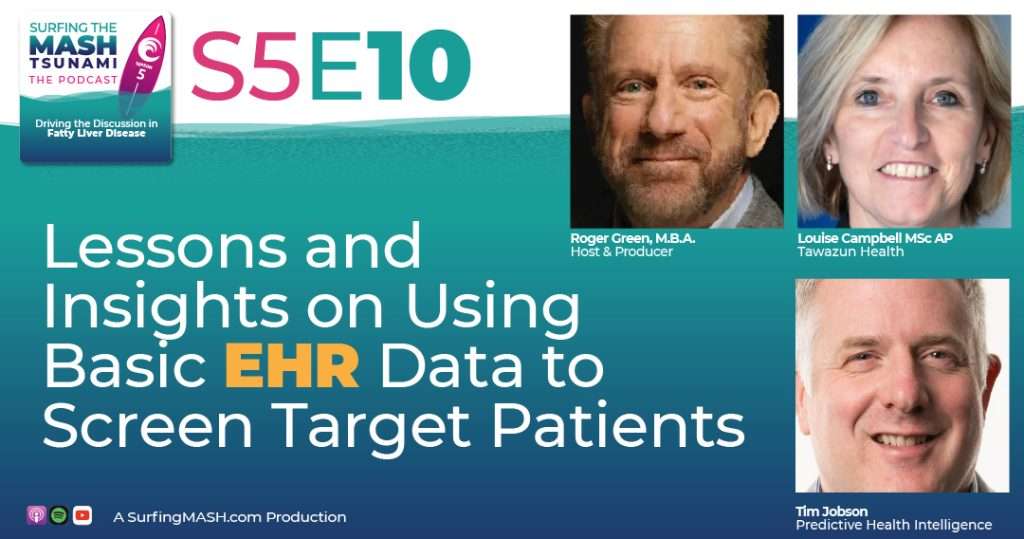
This episode is a follow-up to Season 4, Episode 5, where we met Tim Jobson. His company, Predictive Health Intelligence (PHI), takes a unique approach to identifying and monitoring MASLD patients using basic EHR data and analytics. This session explores PHI’s work over the past years and considers implications for several liver-related health challenges.
00:00:00 – Surf’s Up: Season 5 Episode 10
00:02:04 – Introduction
00:03:29 – Groundbreakers
00:07:02 – New projects from Tim
00:12:46 – Sequential testing
00:15:33 – Data governance and privacy
00:22:31 – Most and least helpful data items
00:25:21 – Thoughts on patient gender and age
00:30:23 – Differences between MASLD and HCV
00:38:38 – Specific challenges in the US
00:41:49 – Keeping data import simple
00:47:18 – Seeking high-value patients more effectively and final question
00:52:52 – Question of the Week
00:53:37 – Business Report
00:00:00 – Surf’s Up: Season 5 Episode 10
Opening comments from the panel, including brief quotes taken directly from the episode.
00:02:04 – Introduction and Groundbreaker
Each panelist shares one piece of good news from the previous week.
00:07:02 – New projects from Tim
Tim discusses the three major activities that PHI has undertaken since our last visit.
00:12:46 – Sequential testing
Roger Green asks Tim to state one key lesson he would like to share with a global audience. Tim speaks of the value of sequential testing and the value of collecting data that will support this effort.
00:15:33 – Data governance and privacy
Louise Campbell asks Tim about privacy issues and GDPR status for these types of basic health information. Tim states that the number of cases where patients have exhibited concerns when they learn the data is helping them get/stay healthier is virtually nil.
00:22:31 – Most and least helpful data items
Tim states that “factual data” (e.g., lab tests) are more valuable than “coded data” reflecting a treater’s point of view.
00:25:21 – Thoughts on patient gender and age
In response to Louise’s questions, Tim shares that his group creates separate analyses by gender, strongly prefers creating risk thresholds to “measures of normality and abnormality,” and already is seeing a trend of patients needing MASLD care at younger ages.
00:30:23 – Differences between MASLD and HCV
Tim discusses some differences in the challenge of bringing in-need HCV patients into the healthcare system compared to in-need MASH patients. HCV patients tend to live at lower socio-economic status, and some who lead high-risk lives may be homeless. MASH patients are more likely simply to lack knowledge and more likely to come to a physician visit once identified.
00:38:38 – Specific challenges in the US
In response to Roger’s questions, Tim identifies two differences in the US today: greater clinician motivation due to Rezdiffra coming to market and a greater need for an inexpensive way to target the right patients and then track whether the drug appears to be working.
00:41:49 – Keeping data import simple
Tim comments that these kinds of activities are challenging enough when data sets and needs are fit to goal and fairly simple, let alone if researchers or policymakers inflate the dataset unnecessarily. This is particularly important because the system can probably locate so many untreated patients using simple data.
00:47:18 – Seeking high-value patients more effectively and final question
Louise and Tim consider what might be the “sweet spot” when patients are ill enough to appreciate that they need treatment but still hardy enough that therapy has time to work. From there, Roger asks a final question about how all stakeholders can contribute to the goal of aggregating large-scale basic sequential data.
00:52:52 – Question of the Week
The question asks what help listeners’ organizations or others like them can offer in providing data or otherwise helping enrich data sources for assessing the value of repeat measures.
00:53:37 – Business Report
This week’s news on audience metrics, post-Rezdiffra episode ideas and this week’s Vault conversation.