
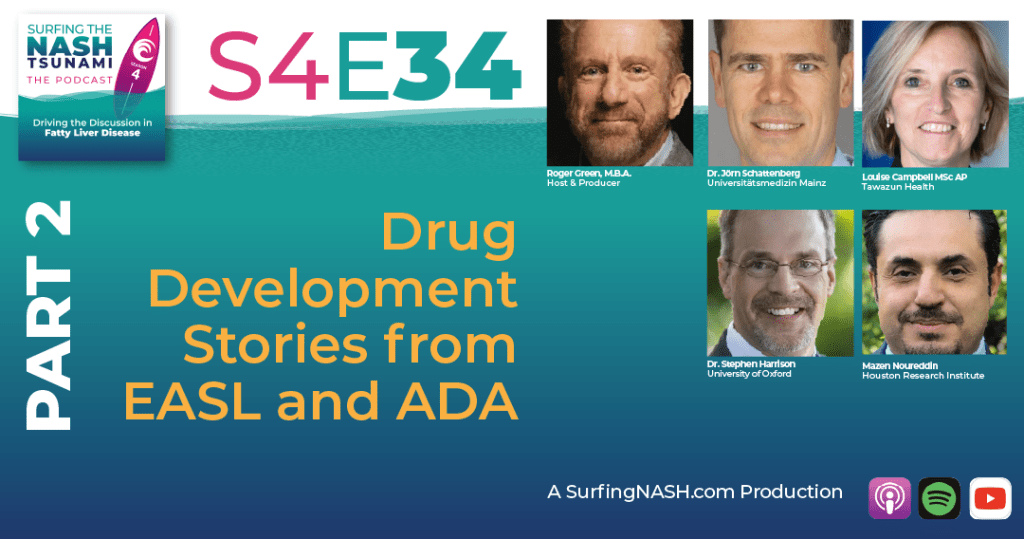
This month, Surfing NASH embarks on a series of episodes dedicated to takeaways emerging from June’s two major conferences: the 2023 EASL Congress in Vienna and the American Diabetes Association’s 83rd Scientific Sessions meeting in San Diego. This is the second session focusing on drug development, and specifically, on several presentations for exciting drugs in development.
This session kicks off with a twist as co-host Jörn Schattenberg introduces the episode and its panelists because Roger Green is late (he will join later with a bit of birthday banter). Joining this in-depth discussion around the latest drug development stories to emerge from the EASL and ADA meetings is Stephen Harrison, Mazen Noureddin and Louise Campbell.
Stephen starts the episode by discussing findings from the Phase 2b FASCINATE trial of the FASN inhibitor denifanstat, as presented at the EASL Congress by Rohit Loomba. After describing key efficacy and safety findings, Stephen notes that denifanstat does pretty much what observers expected it to do. Mazen follows up with a series of questions noting that denifanstat’s efficacy does not appear equal to the FGF-21s efruxifermin and pegozafermin, and asks whether it will become a “front-line” or “add-on” agent. In response, Stephen suggests we will need a plethora of modes of action, that orals and injectables will each have a place depending on the type of patient, and that this will compete for front-line use in less severe patients and maintenance use in more severe patients with the other oral agent classes. From here, the conversation moves on to discuss the increasing importance of omics and epigenetics, and the role these may play in the future.
This is the point at which Roger joins the discussion. Because Mazen has to leave, Roger asks him a broad question about markers for the future; Mazen bases his answer on the anticipated future approval of resmetirom. After he leaves, Stephen presents results from the Phase 2b study for the dual GLP-1/glucagon agonist pemvidutide, which wanders into the importance of the actual GLP-1-to-glucagon impact ratio, potentially significant safety signals that remain to be fully studied, and the subject of how much lean muscle mass these agents produce. This leads Louise Campbell into a brief but fascinating comment on the psychological impacts of lean muscle mass on different patients.
In the final question, Roger asks the group what we have learned in the previous month that might affect research design or disease strategy thinking going forward. The answers vary widely, and each has value.
If you have questions or comments around the EASL Congress or ADA meetings, the discussed therapeutics, new nomenclature, or any other topic addressed in this episode, we kindly ask that you submit reviews wherever you download the discourse. Alternatively, you can write to us directly at questions@SurfingNASH.com.
Stay Safe and Surf On