S4-37.4 – NASH Patient Care: The Value of Patient Education
What do liver nursing KOLs see as the largest, most important changes they can hope for 2-3 years from now?

What do liver nursing KOLs see as the largest, most important changes they can hope for 2-3 years from now?
As efficacious NASH drugs near the market, what steps can we take to ensure that patients receive treatment early enough in the course of therapy?
How does the misalignment of liver patients’ needs and nursing availability limit chances to intervene early in the course of Fatty Liver disease?

Nursing KOLs discuss the extensive backgrounds and diverse skill sets they bring to the challenge of educating Fatty Liver patients early in disease progression.
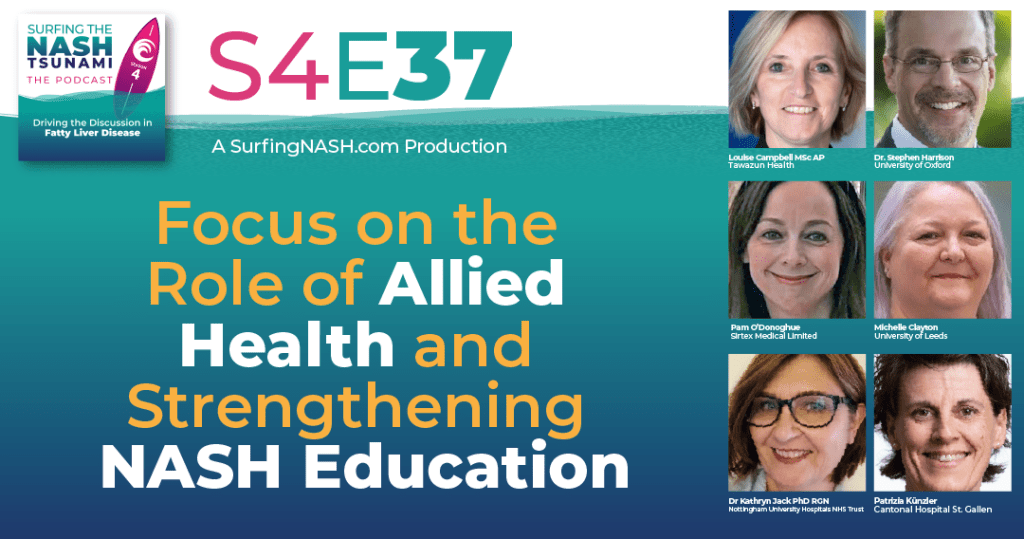
This week, Surfing NASH looks back at a Season 3 episode that remains particularly relevant in light of recent stories on new nomenclature and therapeutic developments for liver disease. An all-star panel of liver nurses and advanced nurse practitioners join Louise Campbell and Stephen Harrison to explore the myriad ways allied health experts can play a broader role in NASH education and patient management.

Ian Rowe, Louise Campbell and Roger Green discuss two issues in NASH patient management: the number of patients that are told they have Fatty Livers not to worry about treating it, and the general challenges in treating patients whose NASH is part of a constellation of metabolic diseases.
New guest, Prof. James O’Breine, joins Naim Alkhouri, Louise Campbell and Roger Green to discuss improving models for patient identification and risk stratification with the LOCATE-NAFLD project. This final conversation addresses the importance of adequate training in order to optimize the potential of advancing technologies. For final questions, James shares what’s next for the project and the other panelists discuss takeaways from this discussion in terms of improving screening or cost effectiveness.
New guest, Prof. James O’Breine, joins Naim Alkhouri, Louise Campbell and Roger Green to discuss improving models for patient identification and risk stratification with the LOCATE-NAFLD project. This conversation focuses on questions around funding before moving on to consider the importance of generating and managing the best sets of data. As the conversation concludes, the group discusses concerns over consistency of scan reads and shares tips on how to get a more accurate measurement.

New guest, Prof. James O’Breine, joins Naim Alkhouri, Louise Campbell and Roger Green to discuss improving models for patient identification and risk stratification with the LOCATE-NAFLD project. This conversation features general comments and questions around the study design before James shares two interesting pieces of data from early analysis.

Naim Alkhouri, Louise Campbell and Roger Green are joined by new guest, Prof. James O’Beirne, to discuss developing improved models for patient identification and risk stratification. Learning from past experiences with HCV, the LOCATE-NAFLD study was born and this episode dives into the project protocols, aims and potential takeaways.